Fascinating mathematics
Interactive online classes for children aged 4 to 12 years.
Arithmetic
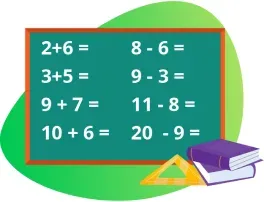
Teach them to solve any question and problem. Build a solid mathematical foundation.
Geometry and ruler
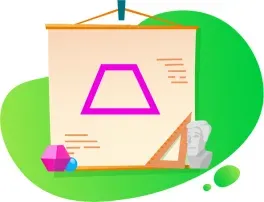
Study even complex geometric figures, teach to use a ruler, and measure mass and distance.
Flexible thinking
Teach flexible and non-standard thinking through solving brainteasers and mental agility exercises.
School preparedness

Regular lessons nurture an interest in learning. A child will then easily adapt to learning at school.
Who will benefit from the course
20 lesson-blocks
Minimum of 6 months
From 4 to 12 years old
Fosters an interest in learning. The children “play” and easily absorb math, learn to puzzle things out, and make non-standard solutions under the teacher’s professional guidance.
especially for kids
Experienced teachers
teach your child new things in a fun way, fill in the gaps in their knowledge, and find the right approach to your child
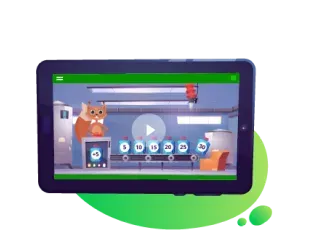
Interactive tasks
each lesson and homework task is a mini-game. Forget about boring lessons!
Edutainment programs
education + entertainment. Engaging classes and interactive homework tasks
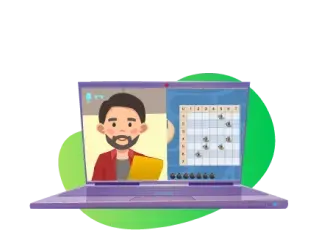
Online platform
study, track your child's progress, and pay for lessons all in one place
The courses includes the following: You only need a computer or tablet for the classes.
After completing the courses, the child will understand and apply basic mathematical concepts, learn to solve problems and exercises, develop intelligence, logic, and spatial thinking, and master the fundamentals of geometry.
Basics of Counting and Modeling Numbers up to 1,000,000,000
Distinguishing between the concepts of “digit” and “number”. Counting forward and backward, number composition, position in a number sequence, number classes and place values.
Problem Solving
Formulating and solving one-step and multi-step problems. Analyzing the problem statement and planning the solution for any word problem.
Basics of Geometry
Studying basic geometric elements and plane figures. Exploring solid figures. Introduction to the concepts of “area”, “volume”, and “mass”. Learning to use a ruler: measuring and drawing simple figures, measuring distances. Studying the coordinate system on a plane and obtaining information using simple graphs.
Understanding the Concepts of “Space” and “Time”
Position and direction in space. Learning the sequence of parts of the day, days of the week, seasons, and months. Studying mechanical and digital clocks. Setting time and relating it to parts of the day. Solving problems to find time intervals.
Developmental Exercises for Logic, Thinking, Attention, and Memory
Solving non-standard logical problems. Special exercises for developing attention and memory.
Course packages
- compare and contrast the main colors and shades;
- count to ten forwards and backwards;
- distinguish between cardinal and ordinal numbers up to ten;
- name the previous and following number for each numeral, and continue counting forwards and backwards from any given number;
- compare neighboring numbers (up to ten);
- use basic mathematical signs;
- design short math problems;
- solve simple math problems involving money (a trip to the store).
- identify and compare the features of different objects and phenomena, using a variety of examination methods;
- recognize 2D and 3D elements and shapes
- orient themselves in space (up, down, in front, behind, between, next to, left, right); compare spatial orientations (higher than, lower than, to the left of, to the right of, above, below, closer than, further than, inside);
- concentrate on the object under study;
- solve non-standard logical problems.
- count to twenty and know the number order;
- distinguish between cardinal and ordinal numbers up to twenty;
- be able to name the previous and the next number for each numeral, continue counting forward and backward from any given number;
- compare neighboring numbers (up to twenty);
- know number compositions (up to twenty);
- solve simple one-digit sums using worksheets;
- create simple sums using visual material;
- work out ways to solve a problem;
- understand and solve simple problems using money in "A trip to the store" (up to 20);
- measure geometric shapes using a ruler, such as a segment, sides of a triangle, quadrangle (square, rectangle), and distance between objects;
- understand and distinguish between mathematical concepts, such as area, volume and mass;
- recognize and set the time on analog and digital watches, calculate time intervals;
- correlate the time on a watch to a part of the day;
- solve logical problems.
- count to one hundred and place each ten in order;
- add and subtract with crossing the next ten;
- perform multiplication and division using object material (up to 20);
- draw flat geometric figures: straight line, segment, sides of a triangle, quadrangles (square, rectangle);
- calculate time intervals;
- find and compare areas of geometric shapes, object volumes and weight;
- solve non-standard logical problems, complete exercises to develop their attention and memory.
- count up to 1000, add and subtract three-digit numbers;
- multiplying and dividing numbers within 1000;
- solve letter expressions and first equations;
- perform geometric constructions using a ruler and compass;
- analyze and create a plan to solve word problems in three steps;
- measure lengths and distances, determine mass, area and volume of figures, work with units of time and the concept of price;
- solve non-standard problems on logic, develop attention and memory.
- model numbers considering classes and place values up to billions, and get acquainted with negative numbers;
- solve problems involving addition, subtraction, multiplication, and division with multi-digit numbers;
- perform arithmetic operations with common and mixed fractions;
- simplify mathematical expressions and solve compound equations using several rules;
- identify the coordinates of points in a coordinate plane and construct figures and simple graphs based on given coordinates;
- understand and solve practical word problems in 3 or 4 steps (finding time, speed, and distance using fractional values);
- solve non-standard logical problems in different ways.
Try now


Kids can study at any time
This course was designed by experienced teachers, They know how to instill a love of reading in your child.



Reviews






Choose a payment option

Top FAQs
Kidskey's Mathematics course includes additional practical tasks and topics that build interest in the subject, and a positive attitude towards math. Kids will learn that solving problems and examples isn't difficult if you know HOW to do it, and will stop being afraid of them. Our teachers will teach your child to look at a problem or sum without fear, to find the right solution and enjoy the success. At Kidskey online school, learning is game-based, and as a result, basic knowledge forms the foundation for mastering more complex material. In addition, classes are conducted one-on-one with a teacher, whose attention is completely focused on your child.
Mathematics is not just numbers, it's counting forward and backward, the ability to solve simple problems, and an introduction to geometry. Math classes develop a child's attention, thinking, and memory. The program at Kidskey is a system of classes, with each lesson building on the material in the previous one, so it's better not to break up the course.
The exercises in the course are designed to not only teach, but also to develop memory, imagination, attention, and thinking. Learning is presented as a game, so the child doesn't even notice that she is learning.
Yes, it would. Each class includes activities to develop attention, memory, imagination and reasoning skills, in the form of rebuses, tasks and puzzles.
Yes, the course will give children the basic math skills they will need in first grade. In addition, the classes include exercises to train memory, attention, logical thinking and imagination. Your child will learn to memorize, orient themselves in space, analyze and draw conclusions, and learn number compositions, which will help them with addition and subtraction.
Learning at the Kidskey online school is based on easy communication between a teacher and a student. There is no rote learning in class. The child plays and learns, and thus understands that math is interesting and easy. Our students enjoy doing their homework on the interactive platform and look forward to their next class. And most importantly, there is no coercion. Kidskey is about learning with fun.
Free trial lesson
We will familiarize you with our platform, select a course, show you how the lessons are conducted, and you will receive free study materials for your child.